When I think about mountains I've climbed that have really left me with a sense of awe almost all of them share a common feature: glaciers. I don't necessarily need to touch the glacier or rope up, but when there's a flowing sheet of ice on a mountain it's a pretty good bet it's going to be a great trip.
Take, for example, any of the big volcanoes in Washington. Most have glaciers. Rainier has both the largest by area (the Emmons) and the lowest elevation (the Carbon) in the contiguous United States. Mt. Adams is just a hike if you go up the south side, but there are glaciers all down the north. Even lowly Mt. St. Helens, dramatically shortened by the blast in 1981 has a glacier forming in the crater.
Go south and you'll find the same kinds of awesomeness. Mt. Hood? Glaciers. The three sisters? Lousy with glaciers. Shasta and Lassen? Glaciers even though they're in California and that's supposed to be warm.
I think it's the fact that around here, glaciers are generally take more effort to get to and represent a level of mystery and danger that is hard to find on a mountain without a glacier. Can non-glaciated peaks be special? Sure, but for different reasons. Like a scramble or incredible meadows.
All this to say if I'm picking a destination for a special trip, it's likely to have a glacier associated with it. That's why I opted for this trip during my gap week between jobs. (Pro-tip: If you have the chance to take a break between jobs, OMG do it!)
We started in the dark because we always seem to start in the dark. Climb to the ridge and hang a right. Pass the first lake and join the PCT. Leave the PCT on a pretty sketchy trail that really shouldn't be considered a "maintained" trail to get around the huge church-like rock and to the pond beyond. All this was just hiking.
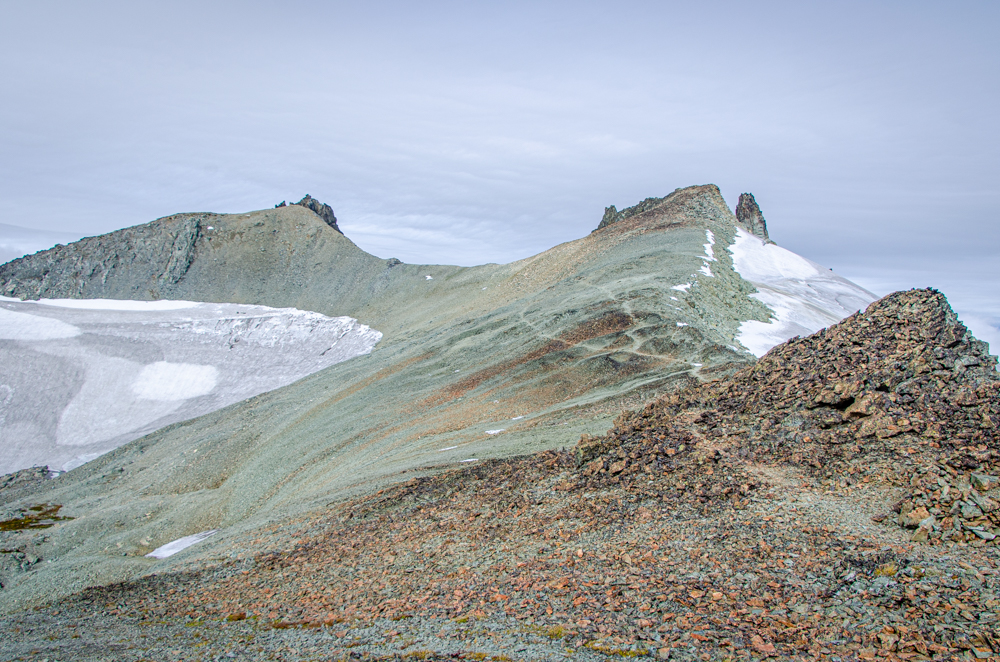
From the lake, the trails fade away and it's just rock. On the right is the glacial trough scoured bare to the bedrock by the glacier that once filled the valley. The ice is still there, but hangs near the head of the cirque. The remaining ice was pitted and cracked at the end of a long summer. A number of tarns were formed by the meltwater. Even right next to each other, they had different colored water thanks to the differing concentrations of glacial flour.
As we walked along the arête between this valley and the next, I had to wear my glasses with their wide arms to block my vision down into the trough. My brain couldn't reconcile the different movement and I would get dizzy if I could see the valley floor in my peripheral vision.
When we got to the end of the valley it wasn't peripheral vision that was giving me trouble. At the head of the cirque was a French policeman that didn't want us to pass. Wait. Nope. It was a gendarme, not a gendarme. (Dang fancy mountain words.)
To continue along the ridge, we had to scramble up, down, and around blocks of loose rock blocking our way. By far, this was the sketchiest part for me. I made each step carefully, let poor Eric lead, and was completely grateful Tinkham wasn't with us. (Even thinking about it now makes my stomach boil with nerves.) Worse, the true crux of the climb, according to everyone I knew that had summited, was just ahead.
The route traversed a steep slope of packed dirt. Not a problem except the slope is covered with tiny rocks that reduced traction to just about nil. They'd slip and slide and maybe you'd come to rest 10 feet down the slope or 1,000 feet down the slope. Previous trips and tried going up and down a bit, but always it wound up being exactly zero fun. Absolutely, something we'd been looking forward to the entire way along.
Except when we got there, the little rocks were mostly gone. Instead there were tracks and solid footing across the slope. No problem! Not that we hopped and skipped across, but it really wasn't that big a deal. Nor was the last little climb past the head of another glacier and a final 20 foot scramble to the summit.
The mountain is the high point not just locally, not just of multiple counties, but of a huge swath of Washington. Views were 360 as far as we could see, though with the clouds that blew through we couldn't always see very far.
In fact, it was the clouds (and the wind and coming storm) that pushed us to head back sooner than I liked. Our trip out was easier as it usually is due to our knowledge of what lay ahead. As we walked away from the cirque and the rock and toward the gentler terrain covered in green, I looked back repeatedly. I took more pictures than I should have and yet somehow still didn't capture the magnificence of the glaciers. We got back to the car just before dark.
Even though there was no overnighting, no real danger, no ropes, and no Type 3 fun, this trip was definitely one of the more intense of the year. Was that because of the presence of glaciers on the mountain? Maybe not, but when I choose the next big adventure you can rest assured it will be glaciated.
(I almost forgot the whole purple thing. We saw the purples. Lots of it. In the sub alpine, where the trees barely have a hold on life, they were purple. Not the leaves. Those were green, of course. But the dead branches that lay bleached among the rocks. Purple. We saw nobody on the mountain itself, but we did talk to a couple of hikers down on the PCT. They declined to see purple. When looking at a piece of wood back at home. No purple. I don't know what that means, but it really was purple! And I bet there will be a part four to this trilogy.)